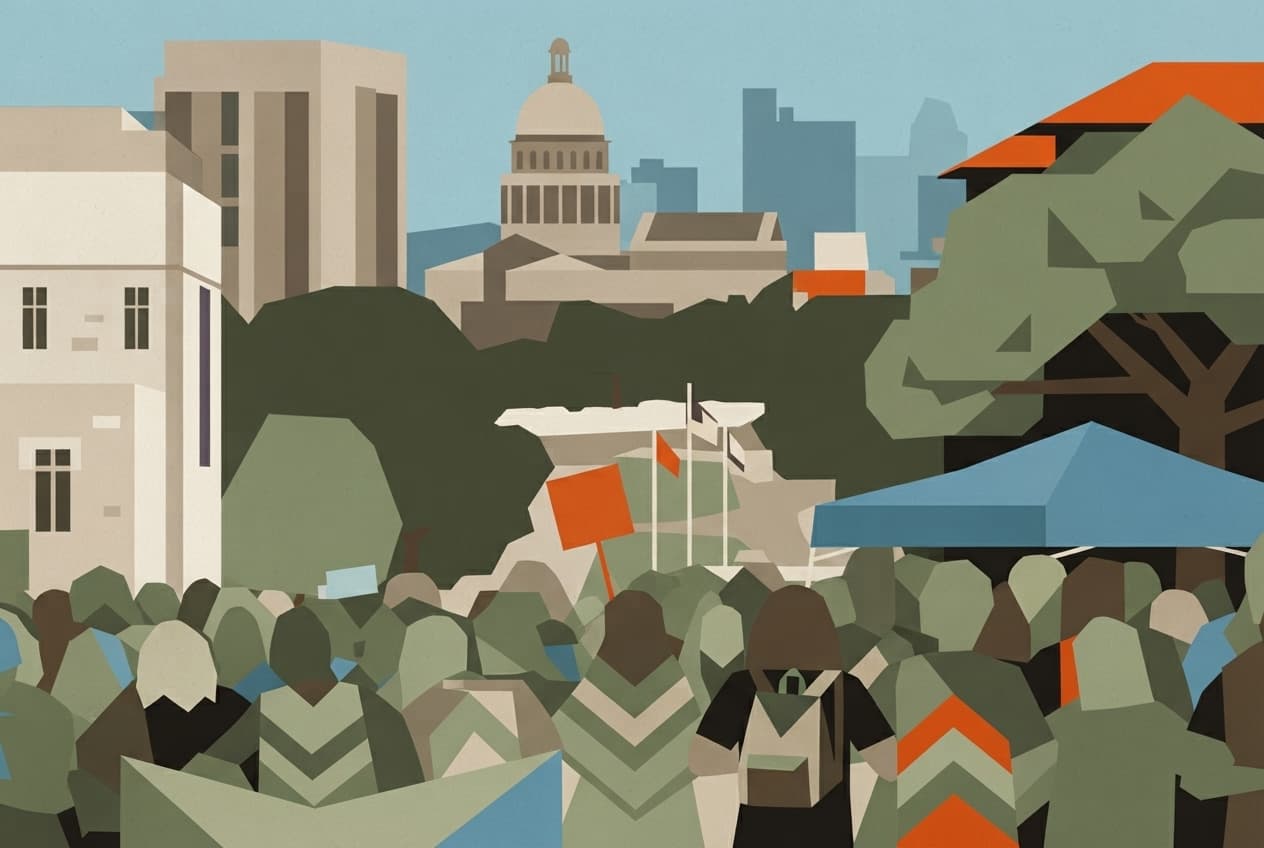
Texas Campus Protest Law Faces First Amendment Challenge
A state law restricting protests on public college campuses, passed in response to 2024 demonstrations, is being challenged in court over alleged First Amendment violations.
A state law restricting protests on public college campuses, passed in response to 2024 demonstrations, is being challenged in court over alleged First Amendment violations.
· Updated
A Texas law that limits protest activities on public college campuses is now facing a constitutional challenge. The U.S. Court of Appeals for the 5th Circuit is reviewing whether the law's restrictions on overnight protests and activities during the final weeks of a semester violate the First Amendment.
Senate Bill 2972, also known as the Campus Protection Act, requires Texas public colleges to prohibit expressive activity between 10 p.m. and 8 a.m. It also bans invited speakers, amplified sound, and percussion instruments during the last two weeks of a semester or term. The law was enacted in 2025 following pro-Palestinian protests that occurred on college campuses across the state in 2024.
Student groups from the University of Texas at Austin and UT-Dallas filed a lawsuit, arguing that the restrictions are overly broad and could potentially stifle legitimate forms of expression. They contend the law could prevent student journalists from working late, religious groups from meeting, or music ensembles from practicing.
A federal judge had previously issued a temporary block on the enforcement of these provisions, finding that the students were likely to succeed in their First Amendment claims and that the restrictions were unconstitutionally broad. However, the UT System has appealed this ruling, leading to the current review by the 5th Circuit.
FAQ
What specific restrictions does Senate Bill 2972 impose on campus protests?
The law prohibits expressive activity on Texas public college campuses from 10 p.m.
Why are student groups challenging this law?
Student groups argue that the law's restrictions are too broad and could infringe upon First Amendment rights by limiting various forms of expression beyond disruptive protests.